
Have you ever filled your air fryer basket with a mountain of fries, pressed start, and expected restaurant-style crispiness, only to discover soft potatoes hiding underneath? You are not alone.
Overcrowding is one of the simplest reasons air-fried food fails to become properly crisp, and it is especially frustrating because the appliance itself may be working perfectly. The problem is often not the temperature, the recipe, or even the amount of oil. It is the amount of food packed into the basket. An air fryer works by moving hot air around the food, so when you squeeze too many ingredients into a small space, you make that job much harder.
Philips specifically advises leaving enough of the basket bottom uncovered so hot air can circulate and cook ingredients evenly. Think of your air fryer like a tiny convection oven with a busy traffic system: if every lane is jammed, the cars cannot move freely. Your food needs that same breathing room. Once you understand this simple principle, you can make crispier fries, better-browned vegetables, crunchier breaded foods, and more evenly cooked chicken without buying a new appliance.
Why Airflow Matters in an Air Fryer
An air fryer does not magically make food crispy simply because it has the word “fryer” in its name. Its performance depends heavily on hot air circulation. The heated air needs to move around the surface of the ingredients, carrying heat to exposed areas and helping moisture escape. That combination is a big part of what creates the browned, dry, crisp exterior people expect from air-fried food. When the basket is reasonably open, the air can reach more surfaces. When ingredients are packed tightly together, however, the environment becomes more crowded and moist, and the food can cook less evenly. Manufacturer guidance reflects this principle: Philips says the basket should not be completely covered because hot air needs room to circulate. The exact ideal arrangement varies by food and appliance, but the basic idea is wonderfully simple: air needs somewhere to go. If your fries seem pale, your vegetables are soft, or your breading lacks crunch, look at the basket before changing the recipe. Sometimes the best “secret ingredient” is simply an empty patch of basket.
What Happens When the Basket Is Too Full
When too much food goes into the basket, several things can happen at once. Pieces can touch one another, overlap, or sit underneath other pieces, reducing the amount of hot air that reaches their surfaces. Instead of every piece receiving similar exposure to the moving heat, some pieces may brown quickly while others remain pale and soft. This is particularly noticeable with foods where surface crispness is the whole point, such as fries, potato wedges, nuggets, onion rings, and breaded vegetables. The situation becomes even more obvious when ingredients release moisture while cooking. Rather than thinking of the air fryer as a deep fryer that can simply accept a larger pile, it is more useful to imagine it as a small convection oven with a strong fan. More food does not necessarily mean more efficient cooking. In fact, Philips recommends shaking foods cooked in more than one layer because doing so helps air circulate and improves even cooking. Your goal is therefore not to make the basket look impressively full. Your goal is to give each piece enough exposure to heat and moving air to develop the texture you want.
Steam, Moisture, and Uneven Browning
Moisture is one of the biggest enemies of a crunchy exterior. As food heats, water inside the ingredients turns into vapor. If pieces are pressed closely together, their surfaces can stay damp rather than drying and browning efficiently. That does not mean steam is “bad” in every air-fryer recipe; moisture is an important part of cooking many foods. But if your goal is a crisp surface, excessive moisture around the food can work against you. This is why a crowded basket can produce the strange combination of food that is technically cooked but somehow lacks that satisfying crunch. You might bite into one fry that is beautifully golden and another that is limp. A little space between pieces gives the hot air more opportunity to reach their exposed surfaces. It also makes shaking or turning more effective. Instead of trying to rescue a packed basket with extra cooking time, start by creating better airflow. Crispness begins with circulation.
The Single-Layer Rule for Crispier Results
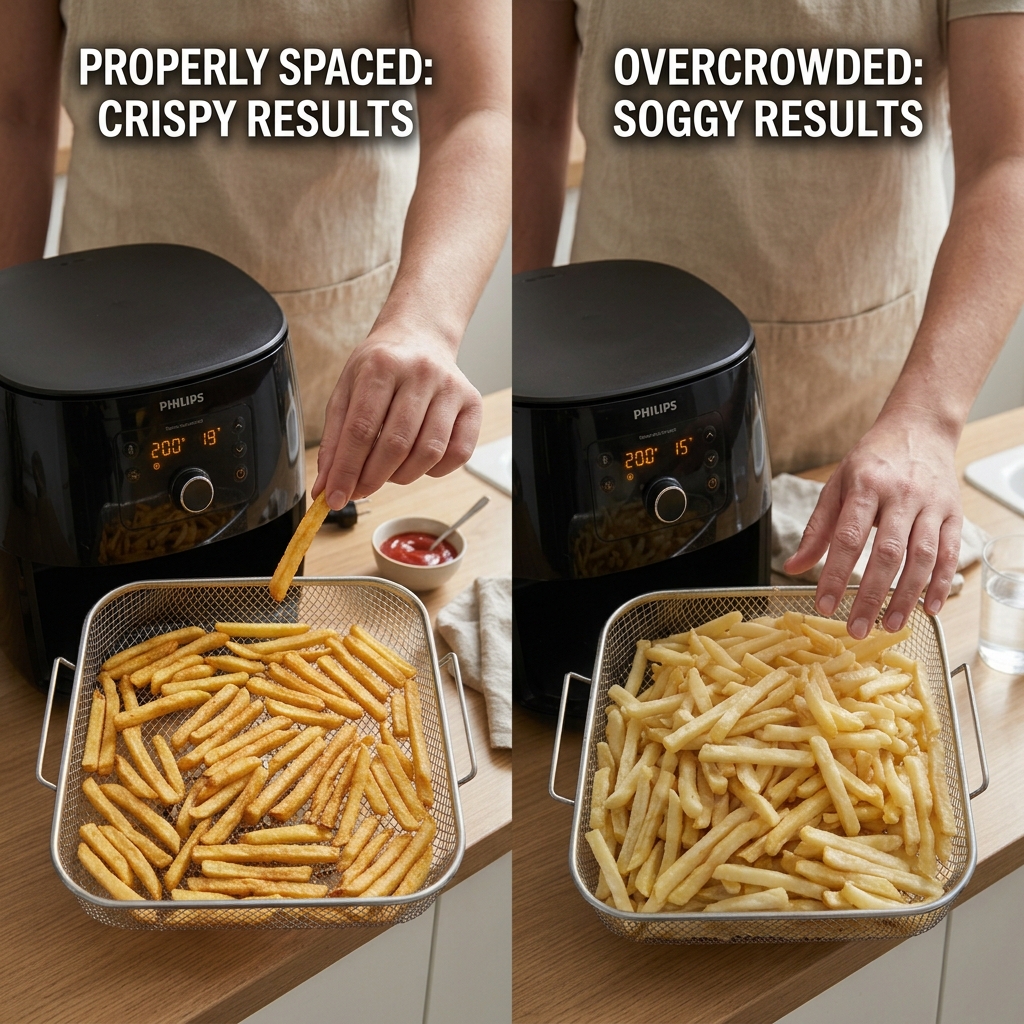
For foods where crispness matters, cooking in a single layer is often the easiest strategy. This does not necessarily mean that every single ingredient must be perfectly separated from every other ingredient. It means you should generally avoid creating a thick pile where many pieces are sitting directly on top of one another. Fries, breaded vegetables, nuggets, and similar foods often benefit from having their surfaces exposed to the circulating heat. Philips recommends one layer for fragile foods and advises leaving enough room between ingredients to handle them easily. A single layer also makes it much easier to see what is happening during cooking. You can notice browning, rearrange pieces, and remove food that finishes early. If your basket is small, this may mean cooking several batches. That can sound slower, but there is an important trade-off: a slightly longer cooking process can produce dramatically better texture. Instead of asking, “How much can I fit?” ask, “How much can I fit while still getting the result I want?”
When Fries Need Extra Space
Fries are probably the easiest food for demonstrating the overcrowding problem. Imagine dropping a large handful of potatoes into a basket until they form a thick mound. The top fries may receive plenty of hot air, while the fries underneath have less exposure. The result can be a mixture of textures: some crisp, some soft, and some somewhere in between. Homemade fries can be especially sensitive because their moisture content and surface preparation affect browning. Philips recommends soaking freshly cut potatoes in water for at least 30 minutes, drying them thoroughly, and lightly coating them with oil before air frying. But even well-prepared potatoes can disappoint when they are packed too tightly. Give the fries room, and shake them during cooking when appropriate. Philips notes that foods cooked in more than one layer should be shaken or stirred to promote more even results. The lesson is simple: good fries need both proper preparation and enough airflow. If your fries are constantly coming out soft, do not immediately blame the potato. Look at the basket.
Leave Small Gaps Between Ingredients
You do not always need enormous spaces between every piece of food. Often, small gaps are enough to make a meaningful difference. Think about a crowded parking lot compared with one where every car has a little room to maneuver. The second arrangement allows movement, access, and easier organization. Your air fryer benefits from the same idea. When vegetables, fries, or breaded foods are packed tightly against each other, the airflow has fewer paths through the basket. Creating small openings allows hot air to move around more surfaces. Philips specifically advises leaving space between certain foods, including fragile stuffed foods, so they can be cooked and removed easily. This is especially useful when you are working with delicate foods that should not be aggressively shaken. Instead of obsessing over creating a picture-perfect arrangement, focus on preventing a solid wall of ingredients. A little breathing room can go a long way toward producing more even browning and better texture.
Why Spacing Improves Browning
Browning happens at the food’s surface, so surface exposure matters. When two pieces are pressed tightly together, the touching areas cannot brown in the same way as exposed areas. You may therefore notice pale lines or soft patches where ingredients have been touching. This is perfectly normal, but it becomes more pronounced when the basket is heavily loaded. Spacing gives more of each ingredient access to the hot circulating air. It also allows you to shake or rearrange the food more effectively halfway through cooking. Instead of seeing spacing as wasted basket capacity, think of it as cooking capacity. A basket filled to the absolute maximum may hold more food but produce less crisp food per batch. A basket that looks slightly less full can deliver a better final texture. That distinction is important because air fryer capacity numbers do not tell the whole story. The usable space depends on the food, its shape, the basket design, and whether the recipe requires turning or shaking.
Cook in Batches Instead of Overfilling
Cooking in batches is perhaps the most practical solution to overcrowding. Yes, it means waiting a little longer. But if you have ever spent twenty minutes cooking an oversized basket only to discover half of the food needs another ten minutes, you already know that “one batch” is not always faster. Two smaller batches can sometimes produce a better result in roughly the same overall window because the food cooks more efficiently. The key is to resist the temptation to treat every spare centimeter of basket space as an invitation to add another handful. Start with a reasonable quantity, cook it, and then use the same basket for the second batch. If the first batch finishes slightly early, keep it warm while the second batch cooks, or return the first batch for a short final crisping session if appropriate. The exact approach depends on the recipe and appliance. What matters most is understanding that batch cooking is not a failure of the air fryer; it is often the correct technique.
Why Two Small Batches Can Beat One Large Batch
A smaller batch has a simple advantage: each piece gets more exposure to the circulating heat. You are essentially giving the air fryer fewer obstacles to work around. This can be particularly valuable for fries, chicken wings, nuggets, cauliflower, zucchini, and other foods where surface texture matters. Philips notes that the more food placed in an air fryer, the more often foods may need to be shaken to achieve even cooking. That is a useful clue: quantity affects how you manage the food. Instead of adding more ingredients and hoping the appliance compensates, reduce the load and make the cooking environment easier. It is like washing a handful of dishes in a sink versus trying to clean an entire stack at once. The smaller load gives you better access and control. If your priority is crispy food rather than maximum food volume, smaller batches are often worth the extra few minutes.
Should You Stack Food in an Air Fryer?
Stacking is not automatically wrong. Some air fryers and accessories are designed to accommodate multiple layers, and certain foods can work well with racks or trays. The important distinction is between purposeful layering with appropriate airflow and simply piling food into the basket. Philips explains that foods cooked in more than one layer should generally be shaken, stirred, or turned during cooking to help achieve even results. Fragile foods are a different story because shaking them can damage their structure. When using a rack, tray, or other accessory, always follow the instructions for your specific appliance and make sure the accessory does not block necessary airflow. You should also avoid assuming that every recipe can be converted from one layer to multiple layers without changing the cooking process. A thick stack of food behaves differently from a shallow layer. If your recipe depends heavily on crisping every surface, multiple layers may require more rearranging and attention.
When Racks and Multiple Layers Make Sense
A rack can be useful when you need additional cooking area and the appliance is designed to support it. It can separate layers and create pathways for hot air, making better use of vertical space than a random pile. Still, the presence of a rack does not mean you can ignore airflow. Philips advises that baking dishes and molds should leave space around the sides so air can circulate. The same basic principle applies to accessories. Think of your air fryer as a miniature room: adding a second floor can be useful, but blocking the doors and windows defeats the purpose. When using multiple layers, choose foods that tolerate rearranging and remember that the upper and lower levels may not brown identically. Turning or rotating the food can help. If you want delicate foods to remain intact and beautifully crisp, a single layer may still be the better choice.
How to Get Crispier Air Fryer Fries
For crispier fries, start with the potatoes rather than immediately changing the temperature. Cut them into reasonably consistent pieces so they cook at a similar rate. If you are making homemade fries, soaking can help remove some surface starch, but drying them afterward is essential because excess water works against crisping. Philips recommends soaking fresh potato pieces for at least 30 minutes, drying them with kitchen paper, and coating them lightly with oil before cooking. Once the fries are prepared, avoid dumping an enormous pile into the basket. Spread them out as much as practical, then shake or rearrange them during cooking if your recipe and appliance call for it. Frozen fries are often already treated or partially cooked and may not require additional oil; Philips specifically notes that pre-fried frozen fries do not need extra oil. The final texture will depend on potato type, cut size, moisture, temperature, and appliance design, but airflow is one variable you can control immediately.
How to Cook Chicken More Evenly
Chicken presents a slightly different challenge because food safety matters as much as browning. You should never rely solely on golden color to decide whether chicken is safely cooked. The USDA states that poultry should reach a minimum internal temperature of 165°F (73.9°C) measured with a food thermometer. That means creating more space in the air fryer can help with even cooking, but it does not replace temperature checking. Arrange chicken pieces so they are not unnecessarily pressed against one another, and turn them when the recipe or appliance instructions call for it. If you are cooking wings, nuggets, tenders, or other smaller pieces, spacing can also help the exterior brown more consistently. Larger chicken pieces may need careful positioning because the thickest portion takes longer to cook than thinner edges. Treat crispness and food safety as two separate goals: airflow helps texture, while a thermometer verifies safe internal temperature. That simple distinction can make your air-fryer chicken both crunchier and safer.
Vegetables That Benefit From Better Airflow
Vegetables can become wonderfully caramelized in an air fryer, but overcrowding can turn them soft and uneven. Cauliflower, broccoli, Brussels sprouts, zucchini, peppers, asparagus, and potato-based vegetables can all benefit from having exposed surfaces. If the pieces are piled together, the bottom pieces may cook differently from those on top. This is especially noticeable with vegetables that release water as they heat. Give them enough room for hot air to circulate, and avoid coating them with excessive oil. Philips notes that oil can be added directly to fresh ingredients to encourage a crispy layer, while emphasizing that oil should not simply be poured into the air-fryer pan. A light coating is usually more useful than drowning the vegetables. Once again, the goal is balance: enough seasoning and oil for flavor and browning, but enough space for the hot air to do its work. If you want those beautiful browned edges, do not bury them under a mountain of vegetables.
Breaded Foods and the Crowding Problem
Breaded foods are another category where overcrowding can quickly ruin texture. Think chicken tenders, mozzarella sticks, onion rings, breaded zucchini, fish fillets, or frozen snacks. The breading needs direct heat exposure to become crisp. When pieces touch, the contact areas may remain softer, and when they overlap, the hidden surfaces cannot brown properly. Fragile breaded foods also require more careful handling because excessive shaking can damage the coating. That is why a single layer is often the safest approach for delicate items. If you need to cook more, prepare another batch rather than creating a tall pile. For packaged frozen foods, always follow the package cooking instructions and your air fryer’s guidance because products vary widely in thickness and whether they are fully cooked. A crunchy coating is not a reliable indicator of doneness for raw poultry products; USDA guidance emphasizes using a thermometer and reaching the appropriate internal temperature.
How Shaking and Turning Improve Results
Shaking is one of the simplest techniques for improving air-fryer cooking. It redistributes the food so pieces that were underneath can move toward the top and vice versa. Philips specifically recommends shaking foods cooked in more than one layer and notes that the more food you place in the appliance, the more often you may need to shake it. This does not mean every food should be aggressively tossed. Fragile foods can break, lose breading, or fall apart. For sturdy fries or potato snacks, however, shaking can be extremely useful. Turning individual pieces can be even better when you are cooking larger foods such as chicken pieces or fish. The timing depends on the recipe and appliance, so use the manufacturer’s instructions as your starting point. The larger lesson is that air frying is not always completely hands-off cooking. A quick shake or turn at the right moment can make the difference between uneven browning and a much more consistent batch.
Common Air Fryer Overcrowding Mistakes
One common mistake is assuming that the basket should be filled because the appliance has the capacity to hold that amount. Another is adding extra minutes instead of reducing the quantity. More cooking time may brown some exposed pieces while leaving crowded areas less successful, especially if moisture remains trapped around the food. A third mistake is piling delicate foods on top of each other and then shaking them aggressively, which can damage the coating or break the food. Another mistake is judging doneness by color alone, particularly with chicken and other meat. Food safety temperatures should be checked with a thermometer when appropriate. USDA guidance says a food thermometer is the reliable way to verify safe cooking temperatures for meat and poultry. Finally, many people change several variables at once: they add more oil, raise the temperature, extend the cooking time, and overcrowd the basket even further. A better strategy is to change one thing at a time. Start with airflow.
A Simple Basket-Filling Test
Here is an easy test you can use the next time you cook. Look at your basket before starting and ask whether the food forms a thick, solid layer with very little visible basket surface. If it does, you may be heading toward an overcrowding problem. Next, gently rearrange the pieces and see whether you can create some small openings between them. You do not need a laboratory measurement or complicated formula. You simply want enough room for hot air to move around the ingredients. For foods that are meant to crisp, a shallow layer is generally a better starting point than a deep mound. Philips guidance similarly emphasizes that the bottom of the basket should not be completely covered so air can circulate and cook the ingredients evenly. Once you develop an eye for the right amount, you will start recognizing overcrowding immediately. It becomes almost instinctive. Instead of asking whether everything fits, you will ask whether everything can cook well.
Does Preheating Fix an Overcrowded Basket?
Preheating can be useful for some recipes and some appliances, but it cannot magically solve overcrowding. Starting with a hot cooking environment may help food begin cooking promptly, but if the basket is packed so tightly that air cannot circulate effectively, the underlying problem remains. In other words, you cannot solve a traffic jam by making the cars start their engines earlier. You still need to create space. Some air fryers are designed to work effectively without traditional preheating, while others or specific recipes may recommend it. Follow your appliance’s instructions and the recipe you are using. Philips, for example, notes on some of its models that preheating is not required. The most important point is that preheating and overcrowding are separate issues. If your food is consistently soft, look at the quantity and arrangement first. A hotter empty basket is not a substitute for proper airflow around the food.
Does Adding Oil Make Crowded Food Crispier?
Adding oil can help certain fresh foods develop a crisp exterior, but oil is not a cure for overcrowding. In fact, adding more oil to a packed basket can simply create a greasy result without fixing uneven airflow. Philips explains that fresh ingredients such as potatoes and chicken can benefit from oil applied directly to the food, while pre-fried frozen foods generally do not need extra oil. The important word is lightly. You want enough oil to support browning and flavor, not so much that the ingredients become heavily coated. If your food is soft because the basket is packed, reducing the amount of food will usually address the underlying problem more effectively than adding another splash of oil. Think of oil as a finishing tool for texture, not a traffic controller for airflow. First create space, then optimize oil and seasoning.
How Basket Size Changes Your Cooking Strategy
A large air fryer basket does not automatically mean you should fill it to the brim. Different foods occupy space differently. A basket that comfortably handles a certain quantity of chicken wings may not be ideal for a similar weight of bulky vegetables. Shape matters, as does whether the food needs turning. The design of the air fryer also matters because airflow patterns differ between models. This is why generic rules such as “fill the basket halfway” should be treated as starting points rather than universal laws. Your appliance’s manual is the best source for model-specific capacity and accessory instructions. Philips, for example, directs users to consult the appliance manual for information about quantities and model-specific guidance. The practical lesson is simple: learn your basket, not just its advertised capacity. After a few cooking sessions, you will know approximately how much food gives you the texture you want.
Air Fryer Capacity vs Usable Cooking Space
Advertised capacity and usable cooking space are not always the same thing. A basket may physically hold a large amount of food, but that does not mean every piece will crisp equally when packed inside. A container can be technically full while being functionally inefficient. This is why experienced air-fryer cooks often prioritize arrangement over maximum volume. If you want crispy fries, for example, the best quantity may be considerably less than the maximum amount that can physically fit. If you are reheating something that does not need significant browning, you may have more flexibility. Your desired result should determine how much you load. Crispy food needs exposure; soft foods may tolerate more crowding. Once you separate capacity from performance, air-fryer cooking becomes much easier to understand. The goal is not to fill the appliance. The goal is to use its airflow effectively.
A Better Routine for Consistently Crispy Food
A simple routine can prevent most overcrowding problems. Start by checking the recipe and deciding whether the food needs a single layer, shaking, turning, or multiple batches. Prepare the ingredients evenly so similarly sized pieces cook at roughly the same rate. Add oil only when appropriate, and apply it to the ingredients rather than simply pouring oil into the appliance. Philips specifically advises applying oil to ingredients and not directly into the pan. Then arrange the food with enough space for hot air to move around it. During cooking, shake or turn foods when appropriate, and check delicate ingredients carefully rather than automatically tossing everything. For meat and poultry, verify safe internal temperature with a food thermometer rather than relying on appearance. USDA guidance identifies 165°F (73.9°C) as the safe minimum internal temperature for poultry. With this routine, you stop treating the air fryer like a magic box and start using it like the precision cooking tool it actually is.
Conclusion: Give Your Food Room to Breathe
If there is one air-fryer lesson worth remembering, it is this: do not confuse a full basket with an efficient basket. Your air fryer needs moving hot air to do its best work, and overcrowding makes that job harder. A single layer, small gaps, occasional shaking, and sensible batch sizes can dramatically improve the texture of everyday foods. Philips guidance supports the importance of keeping airflow paths open and shaking foods when multiple layers are used. You do not need complicated equipment or a secret restaurant trick. Sometimes the biggest improvement comes from putting less food into the basket.
So the next time your fries are disappointingly soft, your vegetables look pale, or your chicken is browning unevenly, pause before changing the recipe. Look inside the basket. Are the ingredients touching everywhere? Are they stacked into a thick mound? Could you divide them into two batches? If the answer is yes, you have probably found the problem. Give your food room to breathe, and let the hot air work its magic. A smaller batch may take a little more time, but crispy, golden, evenly cooked food is usually worth those extra few minutes.
FAQs About Air Fryer Overcrowding
1. Can I completely fill my air fryer basket?
You can physically fill many baskets, but maximum capacity does not always produce the best cooking result. For crispy foods, avoid creating a dense pile that blocks airflow. A smaller quantity arranged with space between pieces will often brown more evenly.
2. Should fries be in one layer in an air fryer?
For the crispiest result, a single layer is a strong starting point. If you need to cook more fries in multiple layers, use an appliance-approved method and shake or rearrange them during cooking when appropriate. Philips specifically recommends shaking foods cooked in more than one layer to improve circulation and evenness.
3. Why are my air fryer fries soft instead of crispy?
Several factors can cause soft fries, including excess moisture, insufficient preparation, unsuitable potato pieces, too much food in the basket, or inadequate cooking time. Overcrowding is particularly important because tightly packed fries have less exposure to circulating hot air. Try cooking a smaller batch with more space between pieces.
4. Can I stack chicken in an air fryer?
Some chicken products can be cooked in multiple layers if your appliance and recipe allow it, but stacking can make browning and cooking less even. Rearranging or turning the chicken may help. Most importantly, raw poultry should reach 165°F (73.9°C) internally according to USDA guidance.
5. Does shaking the basket make food crispier?
Shaking can improve even cooking by moving pieces around and exposing different surfaces to the circulating air. It is especially useful for sturdy foods such as fries and potato snacks. Fragile foods should be handled more carefully because shaking can damage them. Philips recommends shaking foods cooked in more than one layer.