

By Sarah Johnson
The first time I made air fryer blooming potatoes, I sliced straight through the bottom of the potato and ended up with a pile of thin, sad little planks. My husband walked in, looked at the cutting board, and asked if we were having potato chips for dinner. We weren’t. But I’ll tell you what: that failure taught me more than any success has, and it’s the reason the method in this article actually works.
If you’ve never seen a blooming potato, picture a regular russet that has been sliced into a hundred thin, connected petals, then crisped in hot air until the edges curl open like a chrysanthemum. The outside turns shatteringly crunchy. The center stays fluffy, almost like a baked potato that went to finishing school. Brush it with garlic butter, scatter cheddar and bacon over the top, and you’ve got a side dish that makes people stop mid-conversation at the dinner table.
This is the version I make most often when guests come over. It’s an air fryer potato side dish that looks fancy and asks very little of you. No deep fryer, no pot of oil to babysit, no splattering. Just a sharp knife, a little patience at the cutting board, and about 45 minutes of mostly hands-off cooking.
Where the Idea Comes From
Blooming potatoes borrow from two food traditions that happen to get along beautifully. The first is the Swedish hasselback potato, which dates back to the early 1950s at a Stockholm restaurant called Hasselbacken. Cooks there sliced potatoes almost all the way through, leaving the base intact, so the slices fanned out in the oven and the edges crisped while the middle stayed tender. It was a simple trick, and it stuck around for decades.
The second inspiration is the fried onion blossom, that famous steakhouse appetizer from the 1980s that turned a humble onion into a centerpiece. Home cooks eventually looked at a russet and thought, “Why not?” The blooming potato is basically what you get when you cross the two. Social media helped it spread, of course, but the technique is old-fashioned cooking at its core: cut thin, keep the base whole, and let heat do the rest.
The air fryer simply makes it easier. Because the hot air circulates around every petal, you get a crisp finish without submerging anything in oil. A few tablespoons of olive oil and butter are all it takes.
Why This Recipe Works
I’ve tested this recipe more times than I’d like to admit, probably fifteen or so, across two different air fryers (a basket style and a small oven style). Here’s what I settled on, and why:
- A cold-water soak. Ten to fifteen minutes in cold water pulls off surface starch, which keeps the petals from gluing together and helps them separate and crisp.
- A two-stage cook. The potato spends most of its time at a moderate temperature so the center cooks through, then gets a hotter blast at the end for crunch.
- Oil and butter, in layers. Oil goes on first because it handles heat well. Butter goes on later for flavor, since milk solids scorch if they sit in the air fryer too long.
- Cheese at the very end. Add it too early and it melts off the sides and burns on the basket. Three minutes is plenty.
The result is a potato with crunchy, almost chip-like outer petals and a creamy heart. It reheats decently too, which I’ll cover below.
A Kitchen Moment Worth Sharing
Last Thanksgiving I made six of these at once for a table of eleven (the air fryer only holds two at a time, so I ran three batches and kept the finished ones in a low oven). My nephew, who normally pushes vegetables around his plate like he’s herding them, ate two whole potatoes and asked if he could take one home. That’s about the highest compliment a twelve-year-old can give a side dish.
What I learned that day: these can be made in stages. Cut and soak the potatoes in the morning, keep them in cold water in the fridge, and cook them when guests arrive. It takes a lot of the stress out of holiday cooking.
Dietary Notes
Plain blooming potatoes are naturally gluten-free and vegetarian. If you skip the butter and use olive oil all the way through, they’re easily made vegan too, and a dairy-free shredded cheese or a sprinkle of nutritional yeast works nicely on top. For a halal-friendly version, use turkey bacon or beef bacon, or leave the bacon off entirely and add a little extra smoked paprika for that savory, smoky note. Everything else in the recipe is plant-based or easy to swap.
Ingredients
This recipe makes 4 servings (one blooming potato each). Total time is about 1 hour 15 minutes, including the soak and the cutting. Active time is closer to 25 minutes.
For the Potatoes
| Ingredient | US Measure | Metric |
|---|---|---|
| Medium russet potatoes (about 8 oz each) | 4 potatoes | 4 potatoes (about 225 g each) |
| Olive oil (or avocado oil) | 3 tablespoons | 45 ml |
| Kosher salt | 1 teaspoon | 6 g |
| Freshly ground black pepper | ½ teaspoon | 1 g |
| Garlic powder | 1 teaspoon | 3 g |
| Smoked paprika | 1 teaspoon | 2 g |
| Onion powder | ½ teaspoon | 1.5 g |
For the Garlic Butter
| Ingredient | US Measure | Metric |
|---|---|---|
| Unsalted butter, melted | 2 tablespoons | 28 g |
| Garlic, finely minced (about 2 cloves) | 2 teaspoons | 6 g |
| Fresh parsley, chopped | 1 tablespoon | 4 g |
For the Toppings
| Ingredient | US Measure | Metric |
|---|---|---|
| Sharp cheddar, freshly shredded | 1 cup | 115 g |
| Cooked bacon, crumbled (optional) | 4 slices | about 60 g |
| Scallions, thinly sliced | 2 | about 30 g |
| Sour cream (for serving) | ½ cup | 120 g |
| Fresh chives, snipped | 2 tablespoons | 6 g |
Equipment
You’ll want a 5- to 6-quart air fryer (or larger), a sharp chef’s knife, a cutting board, two wooden spoons or chopsticks, a large bowl for soaking, a pastry brush, and paper towels. A meat thermometer is handy but not required.
Ingredient Spotlight: Why Russets?
I’ve tried Yukon Golds, red potatoes, and even a few sweet potatoes in this setup. Russets win, and it isn’t close. They’re high in starch and low in moisture, which means the petals dry out and crisp beautifully while the interior turns light and fluffy. Yukon Golds taste lovely and have a buttery quality, but their waxier flesh doesn’t open up as dramatically. They tend to stay a bit tight and dense.
When you’re shopping, pick potatoes that are similar in size and shaped more like a long oval than a perfect sphere. Oval potatoes fit the air fryer basket better and give you a more even bloom. Avoid any with green patches, sprouts, or soft spots. And if you can, choose potatoes about 3 inches (7.5 cm) wide. Anything much bigger takes forever to cook through, and anything smaller will bloom with fewer petals.
On cheese: I use a block of sharp cheddar and shred it myself. Pre-shredded bags are coated with anti-caking starch, which keeps the cheese from melting into that glossy blanket you want. It’s a small extra step, but worth the thirty seconds.
Substitutions That Actually Work
- Oil: Avocado oil handles higher heat and has a neutral flavor. Canola or vegetable oil works fine too. I’d skip extra-virgin olive oil if you’re cooking above 400°F (200°C), since it can taste bitter.
- Butter: For dairy-free, use melted vegan butter or just more olive oil. The flavor is a little different, but still good.
- Cheese: Gruyère, Monterey Jack, smoked gouda, or pepper jack all melt well. Parmesan is excellent for a sharper, saltier finish, though add it with the cheddar rather than on its own.
- Bacon: Crumbled turkey bacon, crispy chickpeas, or toasted breadcrumbs add crunch and savory depth.
- Sour cream: Plain Greek yogurt is a good swap, with a little extra tang. Cashew cream works for vegan.
- Seasonings: No smoked paprika? Use regular paprika plus a pinch of cayenne. No garlic powder? Use more fresh garlic in the butter, but don’t add fresh garlic before cooking, as it burns.
Quick Prep Notes
Shred your cheese and cook your bacon while the potatoes soak. That way everything is ready the moment the potatoes come out of the air fryer, and you won’t be scrambling at the last minute. Trust me on this one. It’s the part I used to forget.
What to Serve With
Blooming potatoes are rich, crunchy, and a little indulgent, so I like to pair them with foods that are fresh, juicy, or tangy. Here are seven combinations I keep coming back to.
1. Grilled or pan-seared steak. This is the classic. The potato plays the role of a baked potato, but with more texture. A medium-rare ribeye or sirloin with a pat of herb butter makes the whole plate feel like a steakhouse night in. The bloom soaks up the juices, which doesn’t hurt.
2. Roast chicken or crispy chicken thighs. Chicken is milder, so it lets the potato shine. A lemon-herb chicken cuts through the buttery richness nicely. If you’re short on time, air fryer chicken thighs cook at the same temperature, so you can sometimes do both in staggered batches.
3. A crisp green salad with sharp vinaigrette. Honestly, this is what I reach for most weeknights. Peppery arugula or butter lettuce with a lemon-Dijon dressing balances the heaviness. Add shaved radishes or cucumbers for extra crunch and freshness.
4. Garlicky roasted broccoli or green beans. Something green and a little charred keeps the plate from feeling beige. Toss broccoli florets with olive oil and garlic, then roast them at 425°F (220°C) while the potatoes finish. Squeeze a little lemon over the top when they come out.
5. Grilled salmon or other fatty fish. Salmon and potatoes have a long, happy history together. The richness of the fish matches the richness of the potato, and a squeeze of lemon makes both taste brighter. A dill-yogurt sauce on the side ties everything together.
6. Coleslaw or a tangy cucumber salad. If you’re serving these at a barbecue or a cookout, coleslaw is the perfect partner. The cool crunch and acidity offset the hot, cheesy potato. A simple vinegar-based slaw is lighter than a creamy one, if you’d like a less heavy plate.
7. Chili or a hearty soup. Here’s a cozy idea for cold evenings: serve the blooming potato alongside a bowl of beef chili or tomato soup. You can even break petals off and use them as crunchy dippers. My kids call it “soup scooping.”
Beverage Pairings
For adults, a crisp lager or a dry pilsner is hard to beat. The carbonation cleans your palate between bites. If you prefer wine, try a medium-bodied red like a Zinfandel or a Côtes du Rhône with steak, or an unoaked Chardonnay or Sauvignon Blanc with chicken and fish.
For a non-alcoholic option, sparkling water with lemon or lime is simple and refreshing. Iced tea (unsweetened or lightly sweetened) works well too, as does a ginger-lime soda. For kids, I like cold apple cider or a glass of cold milk. Yes, really. It goes surprisingly well with cheesy potatoes.
Sauces and Dips
A blooming potato is basically an edible dip delivery system, so don’t skimp here:
- Classic sour cream and chives. Always a winner.
- Garlic aioli. Mix mayonnaise, minced garlic, lemon juice, and a pinch of salt.
- Chipotle ranch. Stir a teaspoon of adobo sauce from canned chipotles into ranch dressing for smoky heat.
- Honey mustard. Sweet and tangy, especially good with chicken.
- Warm queso. For game day, this is dangerously good.
Garnish Ideas
Fresh herbs make these look as good as they taste. Try snipped chives, finely chopped parsley, or thinly sliced scallion greens. A small sprinkle of flaky sea salt right before serving adds a nice crunch, and a dusting of smoked paprika gives the potatoes a deep red color. If you like heat, scatter a few pickled jalapeño slices over the top.
Step-by-Step Cooking Process
Read through the steps once before you start. The cutting is the only fiddly part, and once you’ve done it, the rest is easy.
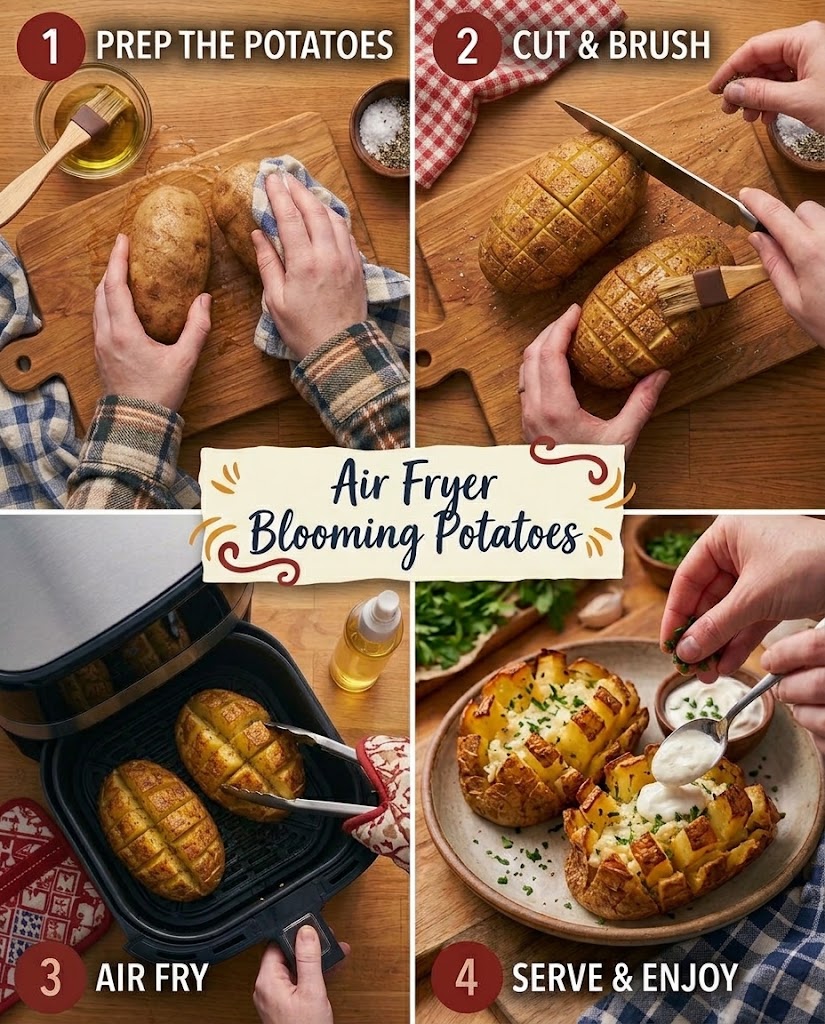
Step 1: Gather and Prep Your Ingredients
Set out everything you need on the counter: potatoes, oil, spices, butter, cheese, bacon, scallions, and sour cream. Scrub the potatoes well under cool running water, since you’ll be eating the skins and nobody wants grit in their crispy petals. Pat them partly dry.
If you’re using bacon, cook it now (in a skillet, in the oven, or in the air fryer at 375°F / 190°C for about 8 to 10 minutes) and crumble it once it cools. Shred your cheese, slice the scallions, and mince the garlic. Having these things ready makes the final assembly feel calm instead of chaotic.
Image prompt (Step 1): Overhead flat-lay photograph of four whole russet potatoes, a small bowl of shredded sharp cheddar, crumbled crispy bacon, sliced scallions, minced garlic, olive oil in a glass bottle, a small dish of smoked paprika, and a wooden spoon, arranged on a rustic weathered wooden table with natural soft daylight coming from a window on the left. Shallow depth of field, warm earthy tones, subtle linen napkin in the corner, realistic food photography, 50mm lens, high detail.
Step 2: Slice the Potatoes Into Petals
Here’s the step that makes or breaks the whole dish. Take a potato and lay it between two wooden spoon handles (or two chopsticks), one on each side. The spoons act as a guard, so your knife stops before it hits the board. This is my favorite trick, and it’s the one that would have saved me on my first attempt.
Using a sharp knife, make thin, parallel slices across the potato, about ⅛ inch (3 mm) apart. Go slowly. Each slice should cut about three-quarters of the way down, leaving about ½ inch (1.25 cm) of solid base so the potato holds together. Don’t worry about being perfect. A few uneven slices won’t ruin anything. If one breaks off, just eat it as a cook’s snack.
When all four are sliced, place them in a large bowl of cold water and let them soak for 10 to 15 minutes. You’ll see the water turn slightly cloudy. That’s the surface starch coming off, which is exactly what we want. Drain them, then pat them very dry with paper towels, gently fanning the slices open to get in between the layers. Be patient here. Wet potatoes steam instead of crisp.
Pro tips for slicing:
- Use your sharpest knife. A dull blade crushes the potato rather than slicing it.
- Cut a thin slice off the bottom of each potato so it sits flat and doesn’t wobble.
- If your slices are thicker than ¼ inch (6 mm), the petals won’t bloom nicely and the potato will take longer to cook.
- Don’t skip the soaking. I’ve tried, and the petals stuck together in clumps.
Step 3: Season and Oil Everything
In a small bowl, mix the olive oil, salt, pepper, garlic powder, smoked paprika, and onion powder into a loose paste. Hold each potato over the bowl and gently fan the petals apart with your fingers, then brush or drizzle the seasoned oil between the layers and over the outside. Work slowly and make sure the oil reaches down into the crevices, since that’s what creates a crispy edge on every slice.
It helps to hold the potato slightly upside down while you do this, so the petals fall open naturally. If you’ve got a silicone brush, use it. If not, a clean spoon and your fingers will do the job. Don’t worry if it feels a bit messy. It’s supposed to.
Image prompt (Step 2): Close-up shot of hands gently fanning open a sliced russet potato over a rustic ceramic mixing bowl, brushing seasoned olive oil with garlic powder and smoked paprika between the thin petals, golden oil glistening, bright natural kitchen light, shallow depth of field, steam-free fresh look, wooden countertop in the soft-focus background, realistic editorial food photography, macro detail on the potato slices.
Step 4: Air Fry in Two Stages
Preheat your air fryer to 375°F (190°C) for about 3 minutes. If your model doesn’t have a preheat setting, just run it for a few minutes empty.
Place the potatoes in the basket, cut side up, with a little space between them. If your air fryer is small, cook two at a time and keep the others covered in the soaking water until their turn. Don’t crowd them. Hot air needs room to move around, and crowding is the number one reason for pale, soft potatoes.
First stage: Cook at 375°F (190°C) for 30 minutes. At about the halfway point, open the basket and check on them. If the tops are browning too quickly, tuck a small piece of foil loosely over them. Every air fryer runs a little differently, so trust your eyes, not just the timer.
Second stage: Raise the heat to 400°F (200°C). Mix the melted butter with the minced garlic and parsley, then carefully brush it over the potatoes, letting it drip between the petals. Cook for another 10 to 12 minutes, until the edges are deeply golden and crisp. The potato should feel soft when you press the base with a fork. If you have a thermometer, the center should read around 205°F (96°C).
Cheese: Sprinkle the cheddar over the potatoes and cook for 2 to 3 more minutes, just until the cheese melts and bubbles slightly. Any longer and it starts to burn at the edges.
Image prompt (Step 3): Two blooming russet potatoes, seasoned and glistening, sitting in the basket of a modern stainless-steel air fryer with the drawer pulled open, a clean contemporary kitchen in the soft-focus background with white cabinets and a window letting in warm afternoon light, a faint haze of heat rising, slight overhead three-quarter angle, realistic home-kitchen photography, crisp detail on the golden-brown petals.
Step 5: Plate, Garnish, and Serve
Use a spatula and a pair of tongs to lift each potato out carefully. The base is sturdy, but the petals are delicate. Let them rest for about 2 minutes on a plate. This lets the inside settle and the cheese set slightly.
Top each potato with crumbled bacon, scallions, a dollop of sour cream in the center, and a sprinkle of fresh chives. Finish with a pinch of flaky salt and a crack of black pepper. Serve right away, while the petals are still crisp. Use a fork to gently pull petals away from the center, or just dig in with your hands. I won’t tell.
Image prompt (Step 4): Beautifully plated blooming air fryer potato on a matte stoneware plate, golden crispy petals fanned open, melted cheddar, crumbled bacon, bright green chives and scallions, a dollop of white sour cream in the center, vibrant colors, a small side of green salad and a lemon wedge, on a dark wooden table with a linen napkin, soft side lighting, shallow depth of field, professional restaurant-quality food photography.
Image prompt (Step 5): Lifestyle shot of a happy family of four sharing dinner at a cozy dining table, a golden cheesy blooming potato in the foreground being pulled apart by a child’s hand, parents smiling and passing plates of salad and roasted chicken in the soft-focus background, warm golden-hour lighting from a nearby window, string lights glowing, candid and natural expressions, rich warm tones, realistic documentary-style food and lifestyle photography.
Troubleshooting: What Went Wrong?
Even experienced cooks run into trouble with this one. Here are the most common problems and how I’d fix them.
The petals won’t separate. You probably didn’t slice thin enough, or you skipped the cold soak. Next time, aim for ⅛ inch (3 mm) slices and soak at least 10 minutes. In the meantime, you can gently pry them apart with a fork after the first 15 minutes of cooking.
The potato fell apart. You cut too deep. Remember to stop about ½ inch (1.25 cm) from the bottom. The chopstick or wooden spoon guard is your best friend here.
The outside is crisp but the middle is raw. Your potatoes were too large or the heat was too high from the start. Stick to the two-stage method, and try microwaving the potatoes for 3 to 4 minutes before seasoning if yours are particularly big.
The petals burned before the center cooked. Tent loosely with foil during the first stage and check that your air fryer isn’t running hot. Many models run 10 to 15 degrees hotter than the dial says.
The cheese slid off and burned on the basket. Add it only in the last 2 to 3 minutes, and press it gently between the petals instead of just sprinkling it on top.
Soggy instead of crispy. Either they weren’t dried well enough, or the basket was crowded. Dry them thoroughly and leave space between potatoes.
Make-Ahead, Storage, and Reheating
You can slice and soak the potatoes up to 8 hours ahead. Keep them submerged in cold water in the refrigerator, then drain and dry them before oiling. Don’t leave them longer than that, as they can start to turn gray and soft.
Leftovers keep in an airtight container in the refrigerator for up to 3 days. To reheat, place the potato in the air fryer at 350°F (175°C) for 5 to 7 minutes, which brings the crunch back quite well. The microwave works in a pinch, but the petals will go soft. I don’t recommend freezing, since the texture suffers.
Pro Tips From My Kitchen
- Use a thermometer if you have one. Fully cooked russets are tender at 205°F to 210°F (96°C to 99°C). It takes the guesswork out.
- Pat dry, then pat dry again. I can’t say this enough. Moisture is the enemy of crunch.
- Season between the petals. Seasoning only the top gives you a flavorful crown and bland middle slices.
- Rotate or flip the potatoes if your air fryer has hot spots. Mine browns the back left corner faster than anywhere else.
- Let them rest briefly. Two minutes makes serving easier and the texture better.
Easy Variations to Try
- Loaded baked potato style: Add sour cream, bacon, cheese, and chives, as in the recipe above.
- Parmesan-herb: Replace the cheddar with finely grated Parmesan and add Italian seasoning to the oil.
- Spicy Tex-Mex: Use pepper jack, a pinch of cumin and chili powder, and top with pico de gallo and avocado.
- Everything-bagel: Brush with butter and sprinkle generously with everything-bagel seasoning for the last 5 minutes.
- Vegan: Use olive oil throughout, a dairy-free cheese, and top with cashew cream and chives.
Final Thoughts
Blooming potatoes look like a lot of work, but they really aren’t. The cutting takes a few minutes, the soaking does its job quietly in the background, and the air fryer handles the rest. Once you’ve done it a couple of times, it’ll feel like second nature.
I hope you give this one a try. Make it for a weeknight dinner, a holiday table, or a game day spread. Chances are someone will ask for the recipe before the plates are cleared, and you can smile and tell them it was easier than it looks.
Happy cooking.